The Silent Saboteur in Your Document Stack
Picture this: Your expensive OCR system proudly reports 97% text accuracy on your latest industrial specification document. Management celebrates. IT gets a pat on the back. Everyone assumes the job is done.
Here's the brutal truth: That 3% error rate just torpedoed your entire question-answering pipeline.
While you're celebrating near-perfect character recognition, that single misread parameter buried on page 47 is about to derail a critical engineering decision. Your retrieval system can't find the right answer. Your AI generates confident hallucinations. Your team makes costly mistakes based on "accurate" data extraction that's fundamentally broken where it matters most.
The $17 Billion OCR Market Has a Dirty Secret
The OCR industry, valued at $17.06 billion and racing toward $38.32 billion by 2030, has been selling you a lie. Traditional OCR benchmarks measure character accuracy like it's 1995, completely ignoring what actually matters: Can you extract actionable answers from real-world documents?
Every major vendor brags about the same misleading metrics:
- 99.2% character accuracy!
- Lightning-fast processing!
- Cloud-native architecture!
- Actually useful for complex industrial documents?
The dirty secret? Most OCR solutions crumble when faced with the messy reality of industrial documentation—dense hierarchical structures, implicit cross-references, heterogeneous formatting, and domain-specific terminology that requires understanding, not just character recognition.
Why Your Current Solution is Failing You (And Your Competitors Too)
Problem #1: The OCR Accuracy Mirage
Your OCR vendor proudly shows you test results on clean academic papers. But when was the last time your facility manual looked like a research journal? Real industrial documents are battlefields of:
- Side-by-side layouts that confuse text flow
- Critical data buried in complex tables
- Specifications scattered across dense technical drawings
- Domain jargon that requires contextual understanding
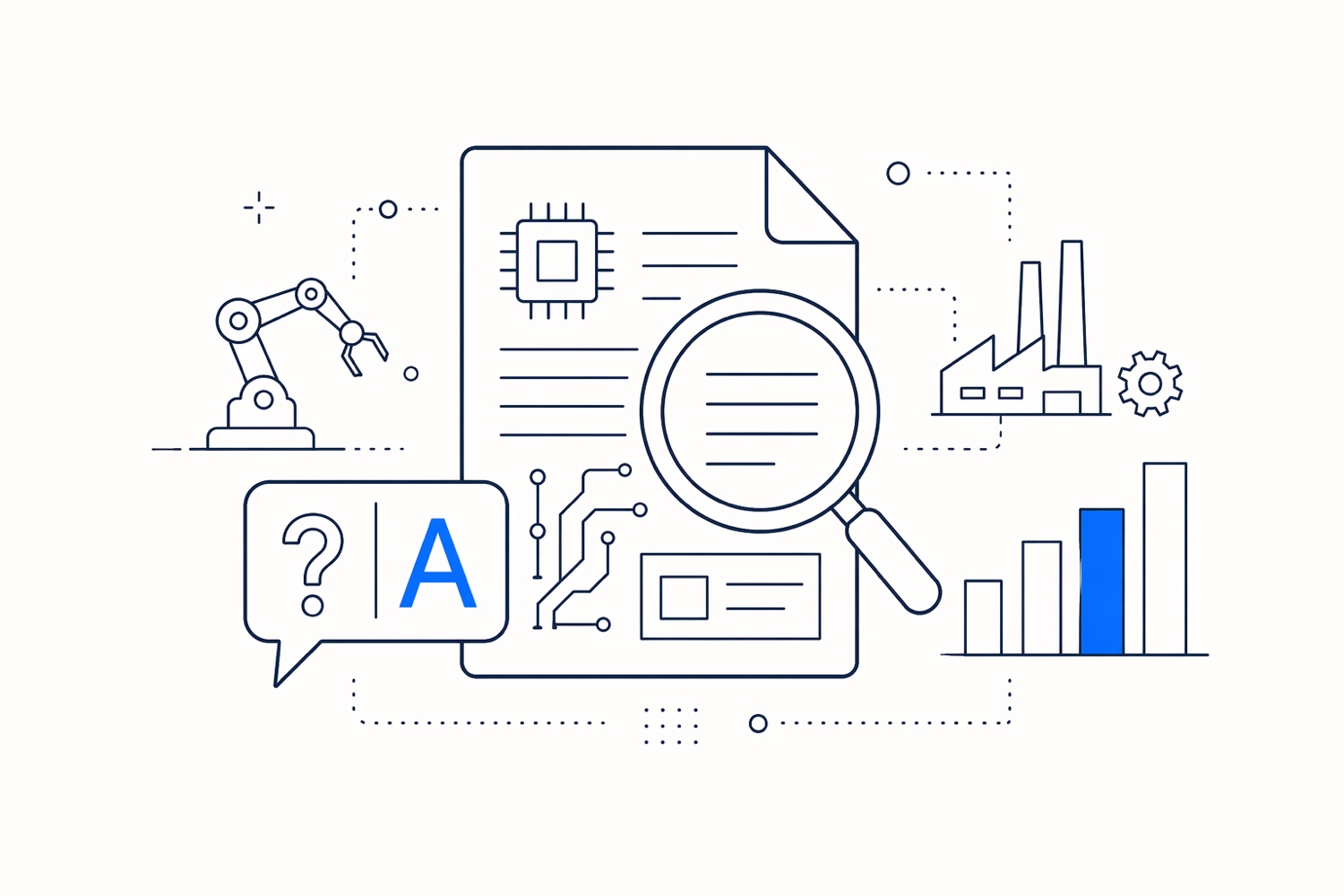
Beyond OCR built for real-world industrial documents. Our platform was built specifically for the messy, complicated PDFs found in factories, plants, and field sites. On TIA-pdf-QA-Bench we outperformed every major solution on the documents that actually matter to you — handling chaos, technical language, and complex reasoning like no other.
Problem #2: The Transformer Tax
The "cutting-edge" solutions everyone's rushing toward? They're LLM-heavy, cloud-dependent resource hogs that:
- Require massive computational overhead for basic tasks
- Force you to send sensitive industrial data to third-party clouds
- Are designed to fine-tune LLMs for the world—and your competitors—using your data
- Demand retraining every time document formats change
- Lock you into expensive usage-based pricing models
No LLM bloat, and your data never leaves your control. Beyond OCR eliminates dependence on massive transformer models — faster processing, drastically lower cost. Run entirely on-premises or securely in-browser; no vendor lock-in or forced cloud uploads; and no forced retraining, because the system adapts on the fly to new document types.
Problem #3: The Chunking Catastrophe
Here's what nobody talks about: OCR is just the beginning. The real issue is how do you chunk that extracted text for retrieval? Poor chunking leads to missed answers, irrelevant retrievals, and AI hallucinations that make your system worse than useless.
Solution: a rebuilt document-intelligence pipeline. Our advanced smart chunking ensures every relevant answer is discovered and irrelevant noise is cut out, maximizing search accuracy and minimizing hallucinations.
This Moment Everything Changes
Remember that 3% OCR error we mentioned? Here's how the Beyond OCR advantages play out:
- Smart Chunking: Our system understands document structure, preserving context across sections
- Semantic Understanding: Domain terminology gets properly linked and indexed
- Error-Resistant Retrieval: Even imperfect text extraction doesn't derail the QA pipeline
- Transparent Results: You see exactly where answers come from, no black box mystery
The result? Questions that would have generated hallucinations or missed answers now return accurate, contextual responses you can actually trust.
Stop Settling for "Good Enough"
The OCR market has trained you to accept mediocrity. Character accuracy percentages. Processing speed benchmarks. Feature checklists that ignore the only metric that matters: Can you reliably extract the answers you need from your most complex documents?
Beyond OCR doesn't just read your documents — it understands them.
Ready to see what document intelligence looks like when it's built for your actual use case instead of academic benchmarks? Your industrial documents are too important for "good enough" OCR. It's time to demand better.